Applied AI · ERPNext
Photo-led Product Intake
Turning product photographs and recovered barcode and price records into editable ERPNext proposals, with a person responsible for approval.
An intake workflow for making sense of messy legacy inventory and creating editable ERPNext product proposals. It brings product photographs, deterministic lookup and human approval into the same process.
The starting point
The legacy inventory did not arrive as a clean set of product records ready to import. Names such as “LOXAGYL 200MG” left out details needed to identify the exact product, strength and pack size. Images were missing too.
11,495 legacy barcode and price records were recovered for lookup. That number describes the lookup material available to the workflow. It is not the number of products automatically processed or approved.
The lookup data lived in a local SQLite database. Looking up buying and selling prices was ordinary SQL. Product identification needed more evidence: the physical packaging, the barcode, the legacy information and, where needed, web research.
How the workflow works
- Capture front and back photographs. The staff-facing page creates a Product Image Intake record. The back photograph needs a readable barcode; the front needs enough packaging to distinguish the variant.
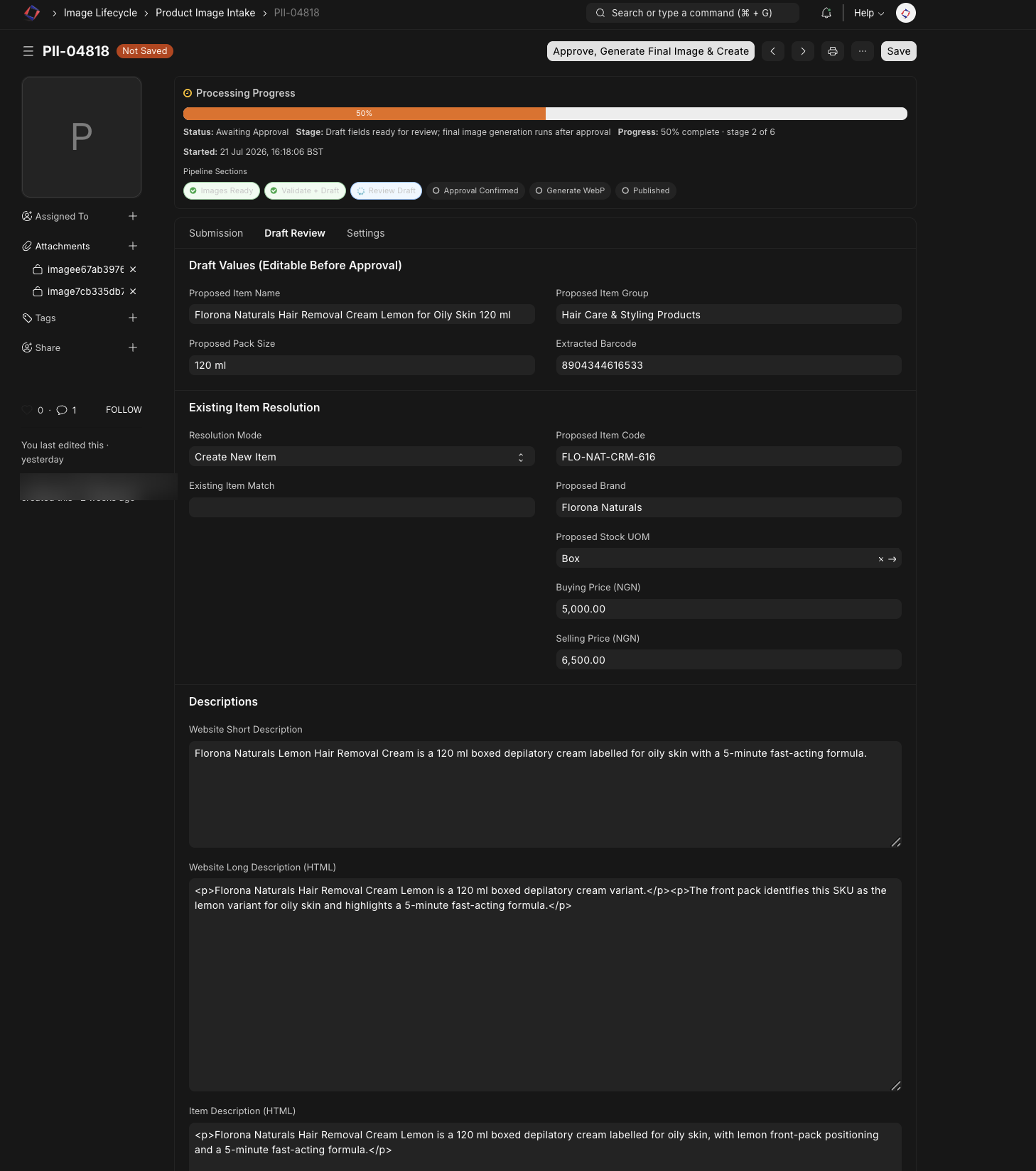
- Validate and draft. The workflow combines that evidence with the lookup data and any necessary research to propose names, item group, brand, pack size, UOM, prices and descriptions.
- Review the proposal. A person checks the proposed values against the photographs and other evidence. The fields stay editable before approval.
- Approve and complete. Approval leads to the final WebP product image and the remaining ERPNext work for the intake.
The original front and back photographs remain on the record beside the generated catalogue image. That keeps the evidence available when a decision needs to be checked later.
Progress at publication
By the article's publication on 4 September 2026, roughly 3,500 products had been processed. This represented around 95% of the inventory chosen to carry forward.
These quantities describe different parts of the work. The 11,495 records supplied lookup material. The roughly 3,500 processed products describe progress with the selected inventory at publication. Neither figure is a claim about model accuracy.
The engineering shape
The project sits within the AmelaStock platform's Frappe and ERPNext context. Its useful boundary is between deterministic lookup, the preparation of a product proposal and a person's decision to approve it. The ERPNext write remains controlled by normal code.
The article also describes the next evaluation questions: keeping photographs of the same product together when splitting development and evaluation data, and retaining difficult examples with similar packaging but different strengths or pack sizes.
Read the original account
The published article is “I Had 11,000 Messy Legacy Inventory Rows. Making Sense of Them Became an ERPNext Workflow”, dated 4 September 2026.
This page is a project summary. Read the full article on Platform Notes or visit its original Blogger publication.